
Feeding the Region: ECOWAS Convenes a High-Level Dialogue on Intra-Regional Food Trade
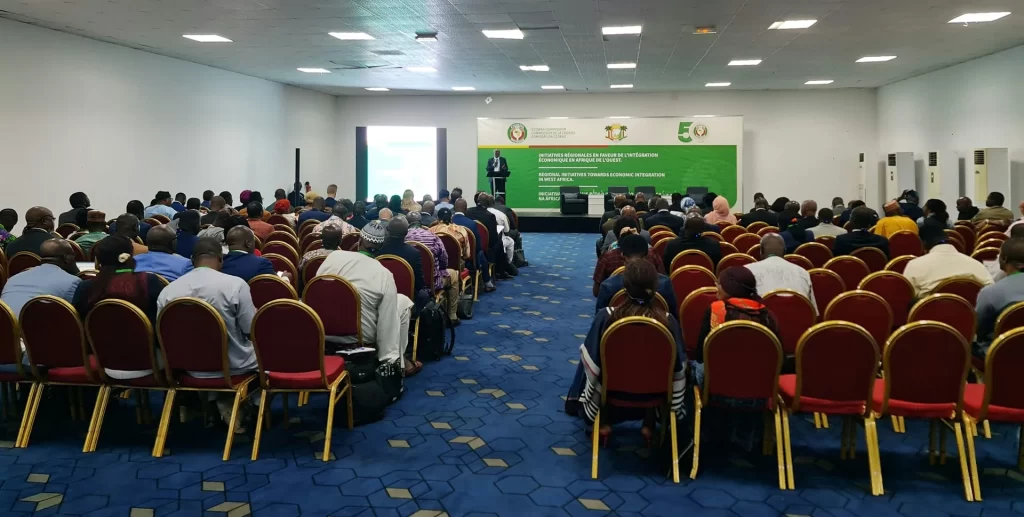
The ECOWAS Commission convened a High-Level Event on Intra-Regional Food Trade in Abidjan on 28 and 29 April 2026, co-organised with an unusually deep bench of institutional partners: the OECD’s Sahel and West Africa Club, known as SWAC, TradeMark Africa, and GIZ, all operating with the support of Germany’s BMZ development ministry. The event ran alongside a broader programme of ECOWAS Commission meetings, part of the Commission’s ongoing work coordinating the region’s integration agenda.
Food trade across West Africa carries a weight that distinguishes it from most other categories of cross-border commerce: delays or barriers affecting food shipments translate quickly into food security consequences for the populations at the receiving end, particularly in a region where production surpluses in one country frequently need to reach deficit areas in another, sometimes urgently, to prevent local shortages from becoming genuine crises.
The seniority of participation at this event reflected that stakes. Ministers and senior officials attended from Côte d’Ivoire, The Gambia, Ghana, Nigeria, and Sierra Leone, a spread of countries representing different points along West Africa’s food production and consumption geography, from major agricultural producers to significant food-importing markets, giving the two-day dialogue perspectives from across that full spectrum.
Institutional representation matched the ministerial seniority, with the ECOWAS Commission and its institutions joined by the AfCFTA Secretariat, AUDA-NEPAD, the Permanent Interstate Committee for Drought Control in the Sahel, known as CILSS, the West African Development Bank, known as EBID, the African Development Bank, the European Union, the World Bank, the International Organization for Migration, TradeMark Africa, GIZ, and Germany’s development cooperation apparatus, alongside private sector and civil society organisations.
That breadth of participation, spanning continental trade institutions, regional development banks, global multilateral organisations, and bilateral development partners all at once, signals how thoroughly intra-regional food trade has become a shared priority across what might otherwise be quite separate development and trade policy communities. Few issues manage to draw the World Bank, CILSS, and AUDA-NEPAD into the same room simultaneously.
The dialogue’s positioning alongside a broader programme of ECOWAS Commission meetings meant the food trade discussion did not occur in isolation but as part of the Commission’s ongoing, wider coordination of West Africa’s regional integration agenda, a structural choice that allowed food trade-specific findings to be considered against, and potentially folded into, the Commission’s broader integration priorities rather than existing as a standalone sectoral concern.
Ghana’s ministerial presence at the event connected directly to threads running through much of Borderless Alliance’s parallel 2026 engagement, including the Ghana Country Dialogue Workshop on agricultural commodities trade held in Accra just two weeks earlier. Both events wrestled with overlapping questions about how West Africa moves food and agricultural commodities across its internal borders, one from a Ghana-specific research and stakeholder angle, the other from a full regional, ministerial-level vantage point.
CILSS’s involvement brought a Sahel-specific dimension to the discussion, given the organisation’s founding mandate around drought control and food security in the Sahelian countries most exposed to climate variability and the resulting food production volatility. Intra-regional food trade functions, in part, as a buffer against exactly this kind of localised production shortfall, allowing surplus from coastal or better-watered regions to reach Sahelian markets facing shortage, provided the trade routes and border processes connecting them function efficiently.
For TradeMark Africa and GIZ, co-organising roles at this event extended their respective institutional footprints, already visible throughout much of Borderless Alliance’s 2025-2026 catalogue of activity, from border infrastructure at Akanu-Noepe to the EU Regional Business Forum side event, into the specific domain of food trade policy, reinforcing how consistently these development partners appear across the full breadth of West African trade facilitation work.
For Borderless Alliance, an event convened with this level of institutional and ministerial seniority offered a valuable vantage point on how intra-regional food trade is being prioritised at the highest levels of West African and international development policy, context that informs the organisation’s own ground-level advocacy on the border friction and agency overlap issues that determine whether high-level food trade commitments actually translate into food reaching the markets and populations that need it, on time and at reasonable cost.