
Beyond the Boundary: Digitising Africa’s Customs Systems at the AfCFTA Digital Trade Forum
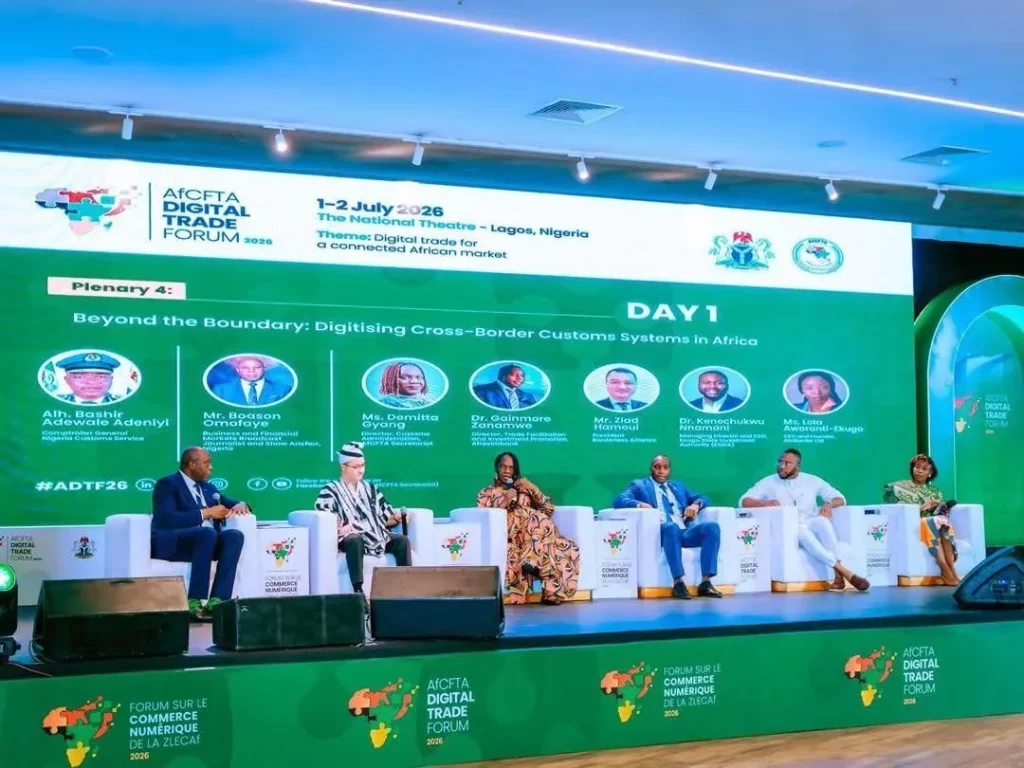
The National Theatre in Lagos hosted the AfCFTA Digital Trade Forum 2026 on 1 and 2 July, gathering delegates under the theme ‘Digital Trade for a Connected African Market’ for a two-day programme co-hosted by the AfCFTA Secretariat and the Government of Nigeria. The Forum’s explicit purpose was to move the African Continental Free Trade Area’s Digital Trade Protocol from the realm of signed agreement into the realm of operational reality.
That distinction, between a protocol’s existence and its operation, runs through much of the broader West African trade facilitation story documented across this catalogue, and it framed the Lagos Forum directly. The Digital Trade Protocol, one component of AfCFTA’s broader legal architecture, sets out rules and commitments governing how African countries handle cross-border digital trade, but a protocol on paper does not, by itself, digitise a single customs desk or harmonise a single data-sharing standard between neighbouring countries.
The Forum’s substantive programme unfolded across multiple plenary sessions, one of which, on Day One, took the title ‘Beyond the Boundary: Digitising Cross-Border Customs Systems in Africa,’ bringing together an unusually senior and varied panel: Alhaji Bashir Adewale Adeniyi, Comptroller General of the Nigeria Customs Service; Boason Omofaye, a business and financial markets broadcast journalist moderating the session; Demitta Gyang, Director of Customs Administration at the AfCFTA Secretariat; Dr Gainmore Zanamwe of Afreximbank; Ziad Hamoui, President of Borderless Alliance; Dr Kenechukwu Nnamani of the Edo State Investment Promotion Agency; and Lola Aworanti-Ekugo, CEO and founder of Allibarter Ltd.
That lineup deliberately spanned the full ecosystem needed to actually digitise cross-border customs: a national customs authority responsible for enforcement, the continental trade institution setting the rules, a pan-African financial institution capable of underwriting the necessary technology investment, a subnational investment promotion body representing the state-level implementation layer, a private trade facilitation advocate, and a private sector technology entrepreneur, all in conversation about the same underlying challenge.
Hamoui’s contribution as a panelist drew on the accumulated ground-level perspective evident throughout Borderless Alliance’s engagement across this catalogue, from the digitalisation panel at LLDC3 in Turkmenistan to the IISD digital trade side event at WTO MC14 in Yaoundé to the digital corridor logistics discussion at the RTFC meeting in Banjul weeks earlier. By July 2026, digital trade had become a subject on which Borderless Alliance could speak with the weight of having engaged the topic across nearly every major forum of the preceding year.
The panel’s discussion worked through what digitisation actually requires of customs systems designed, in most African countries, around paper-based, manual processes accumulated over decades. Genuine transformation demands more than digitising individual national systems in isolation; it requires interoperability, the ability of one country’s digital customs system to actually communicate with its neighbour’s, without which each country’s digitisation effort remains an isolated island rather than part of a connected regional network.
Panellists highlighted three specific needs as foundational to that transformation: interoperable customs systems capable of exchanging data across borders, paperless trade that eliminates the physical documentation still required at many crossings even where digital alternatives exist, and secure cross-border data exchange that protects sensitive trade and personal information as it moves between national systems that may have different data protection standards and capacities.
The panel underscored that achieving these three elements depends on collaboration among governments, customs administrations, and the private sector, a framing that positions digitisation as an ecosystem-wide undertaking rather than a purely technical, government-led rollout. Private sector actors like Borderless Alliance and technology firms like Allibarter, alongside financial institutions like Afreximbank capable of financing the necessary infrastructure, each hold pieces of the puzzle that government customs authorities cannot assemble alone.
The Forum closed with an eight-point calls to action, a concrete roadmap intended to carry the Digital Trade Protocol’s ambitions from statement of intent toward practical execution, echoing the same implementation-focused urgency the ECOWAS Commissioner had voiced in Banjul just weeks earlier, that the region’s challenge lies less in drafting frameworks than in the harder, more granular work of making them operational at the level of individual customs desks and data systems.
As the final major event in this catalogue’s chronological span, running from the Africa Resilience Forum in Abidjan in October 2025 through to Lagos in July 2026, the AfCFTA Digital Trade Forum offers a fitting close: a full year of Borderless Alliance’s advocacy, spanning border infrastructure, committee oversight, regional consultations, and ministerial diplomacy, converging on the same conclusion voiced repeatedly across nearly every forum along the way, that West Africa’s trade facilitation future depends less on new commitments than on the patient, technical work of making existing ones real.