
Inside the Akanu Joint Border Post: A Technical Visit Charts the Road to Completion
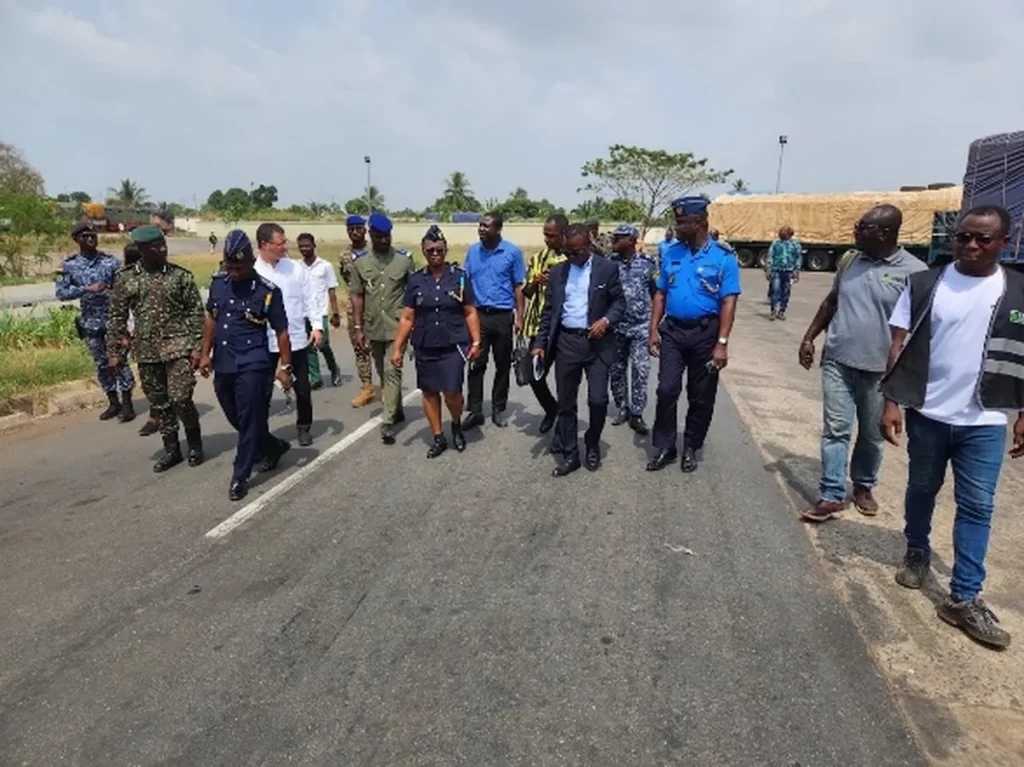
There is a particular kind of value in walking a site rather than reading about it, and that is exactly what brought Borderless Alliance to the Akanu Joint Border Post on 11 February 2025. The visit was organised by TradeMark Africa in its capacity as lead implementer of infrastructure works at the crossing, and it drew together the people who actually have to answer for the border’s day-to-day performance: the agencies who staff it, the technical teams building it, and the private-sector voices, Borderless Alliance among them, who represent the traders who pass through it every day.
Borderless Alliance’s presence was not incidental. The organisation sits on the Country Programme Oversight Committee of TradeMark Africa for Ghana, known within the trade facilitation community as TMA CPOC-GH, a body created precisely so that TradeMark Africa’s West Africa programme does not run on autopilot but stays answerable to the institutions and businesses it is meant to serve. A technical visit of this kind is where that oversight function stops being theoretical and becomes a matter of walking the ground, inspecting what has been built, and noting what has not.
Akanu itself carries more weight than its size might suggest. It sits on the Ghana side of the Ghana-Togo frontier, feeding directly into the Abidjan-Lagos Corridor, one of the busiest and most economically consequential trade routes in West Africa. Goods moving between Ghana, Togo, Benin, Nigeria and onward markets pass through crossings like this one, and every hour lost to a broken barrier, a flooded yard, or an overwhelmed inspection bay is an hour added to the cost of doing business across the subregion.
The visit’s purpose was narrow and practical: to inspect ongoing construction and take stock of the expansion still required, alongside repairs that had been flagged but not yet resolved. This is unglamorous work. It does not produce the kind of headline that a ministerial conference does, but it is the work that determines whether a joint border post actually functions as one, with shared facilities and coordinated processing, rather than as two separate national posts that happen to sit next to each other.
What the delegation found on the ground shaped much of the discussion that followed. Joint border posts are, in principle, a straightforward idea: bring the agencies of two neighbouring countries into a single facility so that a truck or a trader clears both sides of the border in one stop rather than two. In practice, getting there requires synchronised construction schedules, compatible utilities, and agencies on both sides willing to co-locate and share procedures. A technical visit is where the gap between the principle and the practice gets identified, item by item.
The inspection was followed by a high-level bilateral meeting, led by representatives of the border agencies operating at Akanu. This is where the technical findings met institutional decision-making. Bilateral engagement of this kind exists because a border post cannot be fixed unilaterally; whatever Ghana builds or repairs on its side has to be matched by cooperation, information-sharing, or reciprocal action from the Togolese side, and vice versa. The agencies used the session to review the challenges that specifically require this kind of joint cooperation, rather than issues either side could resolve on its own.
Out of that review came agreement on additional steps to be undertaken, a modest but important outcome. Infrastructure projects of this scale rarely move forward on a single decision; they advance through a sequence of agreed next actions, each one narrowing the list of unresolved problems. The steps agreed at Akanu in February 2025 were not made public in granular detail, but their significance lies in the fact that they were arrived at jointly, by the agencies who will have to implement them, rather than imposed from outside.
For Borderless Alliance, participation in visits like this one is consistent with the role the organisation has carved out for itself over the years: not simply advocating from a distance for smoother trade, but showing up at the physical points where trade actually gets slowed down or sped up. A border post’s design, staffing, and infrastructure determine, more than almost any policy document, how long a consignment sits waiting and how much that wait costs the trader who owns it.
The stakes at Akanu extend well beyond the immediate footprint of the crossing. West African economies remain heavily dependent on cross-border trade in food, manufactured goods, and raw materials, much of it carried by small and medium-sized traders who cannot absorb long delays the way larger firms sometimes can. A functioning joint border post at Akanu is a small piece of the much larger ambition of the African Continental Free Trade Area, which depends on physical borders working smoothly if its tariff preferences and market access commitments are to mean anything on the ground.
The February visit set the stage for the follow-up that came just two days later, when the TMA CPOC-GH committee convened in Accra specifically to take stock of what had been seen at Akanu and to fold those findings into the committee’s broader oversight of TradeMark Africa’s work in Ghana. That the two events happened back to back was not a coincidence; it reflects how Borderless Alliance and its partners try to keep site-level observation and institutional decision-making tightly linked, so that what is found on the ground does not sit unaddressed in a report somewhere.