
Corridors, Coastal Shipping, and Compliance: Borderless Alliance’s Side Event at the EU Regional Business Forum
The EU Regional Business Forum ran in Abidjan from 30 March to 1 April 2026, and on its middle day, 31 March, Borderless Alliance stepped out of its usual role as participant and into the role of organiser, convening a side event under the theme ‘Status of Implementation of Regional Regulations across ECOWAS Region.’ The choice of theme was pointed: rather than debate what regional trade regulations ought to say, the session asked the harder question of whether the regulations already agreed were actually being followed.
Three objectives framed the session’s design. First, to support implementation of EU-backed regional transport and trade facilitation reforms along strategic West African corridors, tying the discussion directly to the European Union’s own substantial investment in the region’s trade infrastructure. Second, to provide a platform for practical dialogue between regulators, corridor institutions, and private sector operators specifically on the Abidjan-Lagos Corridor. Third, to promote multimodal transport solutions, including coastal shipping, as a complement to the road corridors that currently dominate West African freight movement.
That third objective, coastal shipping as a complement to road transport, reflects a genuinely underexplored angle in West African trade facilitation discourse, one that typically fixates on road corridors and their border crossings almost to the exclusion of maritime alternatives along the same coastline those corridors parallel. Borderless Alliance’s decision to foreground this theme signalled an interest in diversifying the region’s trade infrastructure conversation beyond its usual road-and-border framing.
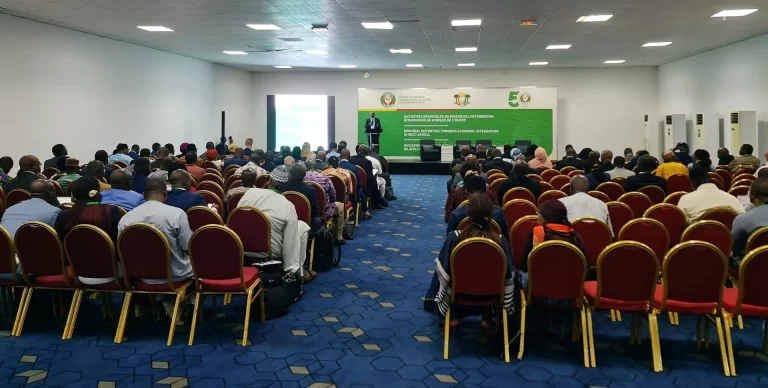
The event drew a genuinely wide-angled audience: representatives from private organisations, government institutions, civil society, international development agencies, and trade practitioners, gathered together in a setting that included Côte d’Ivoire’s own transport security officials in uniform alongside TradeMark Africa representation and European development partners, visible through EU, AFD, Canada, and Gates Foundation branding present at the venue.
A moderated panel discussion anchored the session’s first half, working through the practical dimensions of regulatory implementation across the ECOWAS region with the kind of candour that a smaller, focused side event can sometimes achieve more readily than a large plenary session. Discussions of implementation gaps, rather than aspirational policy statements, tend to require exactly this sort of intimate, practitioner-heavy setting to surface honestly.
The session’s second major feature was a showcase presentation about AFROPAX, an upcoming regional maritime initiative aiming to enhance intra-regional trade and transport by connecting the coastal cities of West Africa. Introducing AFROPAX at this particular side event tied the abstract case for multimodal transport diversification to a concrete, named project, giving attendees something tangible to evaluate rather than only a general argument for coastal shipping’s potential.
AFROPAX’s premise, connecting West Africa’s coastal cities by sea rather than exclusively by road, addresses a structural inefficiency in the region’s current transport geography: many of West Africa’s largest population and commercial centres sit directly on or near the coast, yet the goods and people moving between them travel almost entirely by road corridors that must also absorb inland and cross-border traffic, congestion that direct coastal shipping routes could, in principle, relieve.
For Borderless Alliance, organising rather than simply attending this side event marked a step up in institutional visibility and initiative-taking within the EU Regional Business Forum’s broader programme. Convening a session, setting its theme, assembling its panel, and introducing a new initiative like AFROPAX to attendees, requires a different kind of institutional standing than participating in someone else’s panel, reflecting the organisation’s accumulated credibility across its years of corridor and trade facilitation advocacy.
The Forum’s location in Abidjan, hosting both this Borderless Alliance side event and, weeks later, the broader ECOWAS regional stakeholder consultation on the future of West Africa, reinforced Côte d’Ivoire’s emerging status across this catalogue of 2025-2026 activity as one of West Africa’s central convening points for regional trade and integration discussions, a role the country’s own economic weight and corridor position naturally support.
Closing out the three-day EU Regional Business Forum, the side event’s focus on regulatory implementation and multimodal diversification left attendees, and Borderless Alliance itself, with a clear marker for what to track in the months ahead: whether the ECOWAS regional regulations discussed on 31 March moved any closer to consistent implementation, and whether AFROPAX’s coastal shipping vision progressed from showcase presentation toward operational reality along the West African coastline.