
Beyond Self-Sufficiency: Ghana’s Country Dialogue on Agricultural Trade and Value Chains
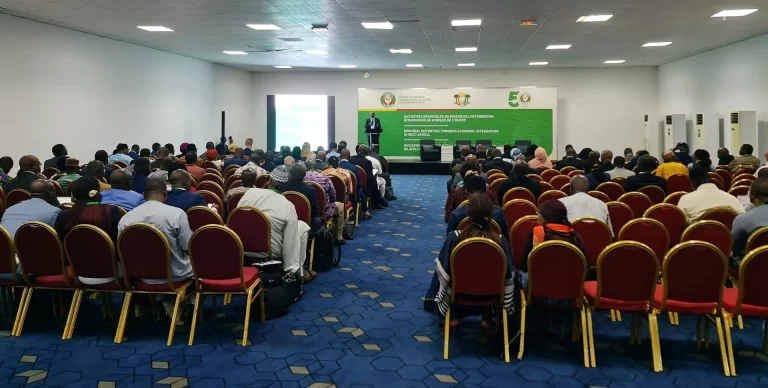
On 15 April 2026, Borderless Alliance took part in the Ghana Country Dialogue National Workshop on Agricultural Commodities Trade, Cross-Border Trade Governance and Financing, a title dense enough to signal exactly how many interlocking issues the day’s discussion was designed to address at once: not just trade, but governance and financing alongside it, and not just trade in general, but agricultural commodities specifically.
The workshop’s organisers, the African Network of Agricultural Policy Research Institutes, known as ANAPRI, working in collaboration with the Institute of Statistical, Social and Economic Research at the University of Ghana, brought a research-driven institutional pairing to the event, one grounded in continental agricultural policy analysis on one side and Ghana-specific economic and social research capacity on the other.
That pairing shaped the workshop’s substance, bringing together key stakeholders to discuss policy, governance, and financing issues affecting agricultural commodity trade across Ghana and the wider West African region. Agricultural trade sits at a particularly consequential intersection for West African economies, where food security, rural livelihoods, and export earnings all depend, in overlapping ways, on how smoothly agricultural commodities can move across borders.
The high cost of cross-border trade emerged as a central discussion point, and participants traced that cost to a specific, recurring culprit: overlapping agency mandates at borders. When multiple government agencies each claim jurisdiction over aspects of the same shipment, customs, agriculture ministries, health and sanitary authorities, security services, traders face duplicated inspections, redundant paperwork, and multiplied opportunities for delay, each additional agency adding cost without necessarily adding proportional value or safety.
Policy unpredictability formed a second major theme, a challenge distinct from but related to institutional overlap. Traders and agricultural producers who cannot reliably anticipate how border policies, tariffs, or documentation requirements will apply from one season to the next struggle to plan investment, storage, and logistics decisions with any confidence, a particularly acute problem for agricultural commodities whose value can deteriorate rapidly if shipments are delayed by unexpected policy shifts.
Limited access to formal finance rounded out the workshop’s core concerns, highlighting a challenge that sits somewhat apart from the border-specific issues of agency overlap and policy unpredictability but compounds them nonetheless. Agricultural traders operating without reliable access to formal credit are less able to absorb the costs of delay or comply with documentation and quality requirements that formal financing might otherwise help them meet, leaving them more exposed to exactly the border friction the workshop’s other themes identified.
Perhaps the workshop’s most significant conceptual contribution was a call participants made for a shift away from broad self-sufficiency goals and toward building regional value chains instead. Self-sufficiency, the aspiration for individual countries to produce enough of a given commodity to meet their own needs without relying on imports, has long shaped agricultural policy across West Africa, but participants argued this framing works against the kind of specialisation and cross-border integration that regional value chains would instead reward.
A regional value chain approach would allow different West African countries to specialise in the agricultural commodities and production stages where they hold genuine comparative advantage, whether in climate, soil, labour, or existing infrastructure, and then trade the resulting outputs across the region rather than each country attempting to replicate full production chains independently. Making that shift work in practice depends heavily on exactly the kind of reduced border friction, harmonised policy, and improved financing access the workshop’s earlier discussion had already identified as missing.
For Borderless Alliance, the workshop’s findings connect directly to threads running throughout the organisation’s broader 2025 and 2026 engagement: the overlapping agency mandates identified here echo concerns raised in the Time Release Study implementation discussions, while the call for regional value chains resonates with the organisation’s consistent advocacy for corridor-based, cross-border economic integration over narrower national frameworks.
ANAPRI and ISSER’s research-driven convening of this workshop added an academic and evidentiary dimension to Ghana’s 2026 trade facilitation calendar, complementing the more implementation-focused work of bodies like the NTFC and TMA CPOC-GH documented elsewhere in this catalogue. Together, the research findings presented in this workshop and the institutional oversight exercised through Ghana’s standing trade facilitation committees form two halves of the same broader effort: understanding agricultural trade’s structural challenges clearly enough, and consistently enough, to actually address them.