
A Ghanaian Perspective in Central Asia: Borderless Alliance at the Third UN LLDC Conference
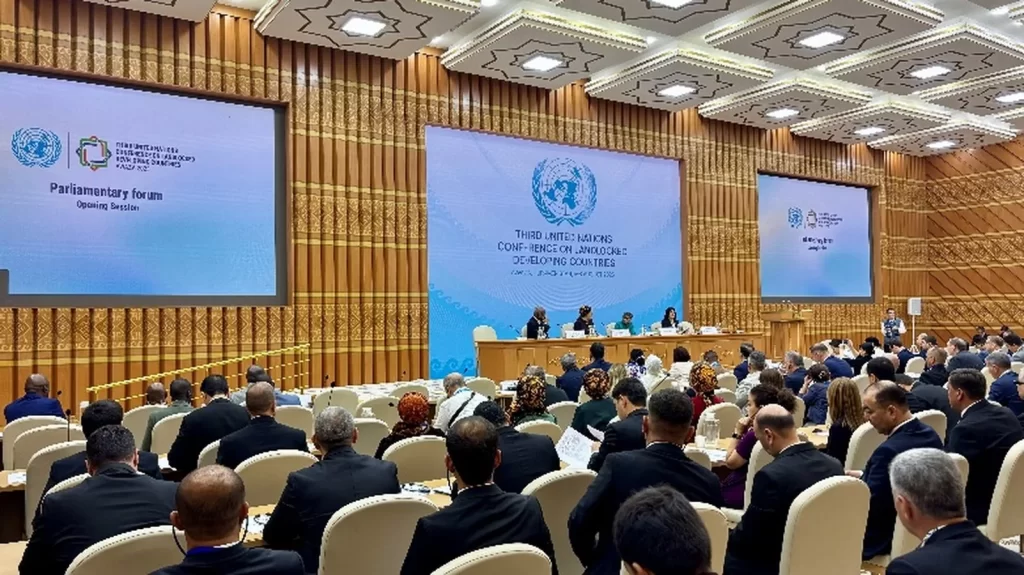
Awaza, a resort town on Turkmenistan’s Caspian Sea coast, is an unlikely setting to find a representative of a Ghana-based trade organisation, but that is precisely where Borderless Alliance’s special representative Yaya Yedan travelled on 5 August 2025 to take part in the Third United Nations Conference on Landlocked Developing Countries, widely referred to by its shorthand, LLDC3.
Landlocked developing countries face a distinct and structural disadvantage in global trade: every import and export must transit through at least one neighbouring country’s territory and infrastructure before reaching a seaport, adding cost, delay, and dependency that coastal nations simply do not confront in the same way. The UN convenes conferences on this issue roughly once a decade, making each edition a significant moment for setting the global agenda on landlocked countries’ trade challenges for years to come.
Ghana itself is not landlocked, which raises the question of why Borderless Alliance would send a representative to a conference specifically focused on landlocked states’ concerns. The answer lies in West Africa’s regional geography: several of Ghana’s neighbours and trading partners, including Burkina Faso, Mali, and Niger, are themselves landlocked, and their trade depends heavily on transit routes running through coastal states like Ghana, Togo, and Côte d’Ivoire. Ghana’s ports and corridors are, in effect, part of the solution to landlocked neighbours’ structural trade disadvantage.
Yedan’s role at LLDC3 extended beyond simple attendance; he contributed as a panelist under the topic ‘Digitalisation of cross-border document exchanges along corridors,’ a subject that sits precisely at the intersection of landlocked countries’ trade challenges and Borderless Alliance’s own institutional expertise. Digital document exchange, replacing paper-based customs and transit documentation with electronic systems, is one of the most consequential reforms available for reducing the delays that compound so heavily for landlocked trade.
For a landlocked country’s exports or imports, delay at any single point along a multi-country transit corridor accumulates, since a shipment might cross several borders before reaching its final destination or a seaport. Digitalising document exchange addresses this compounding effect directly, since electronic documents can move ahead of, or alongside, the physical shipment, allowing subsequent border posts to begin processing before the goods themselves arrive, rather than each border starting its paperwork from scratch.
Yedan’s contribution to this panel would have drawn on Borderless Alliance’s practical experience monitoring exactly these kinds of corridors in West Africa, where the organisation has long observed how document-related delays, redundant paperwork, inconsistent formats between countries, missing digital infrastructure at certain posts, compound as goods move along multi-border routes like the Abidjan-Lagos corridor or the routes connecting Ghana’s ports to landlocked Burkina Faso and beyond.
The conference’s proceedings and outcomes were significant enough to be summarised by the UN itself, with the Office of the High Representative for Least Developed Countries, Landlocked Developing Countries and Small Island Developing States publishing coverage of the conference’s conclusion and its endorsement of the Awaza Programme, a successor framework intended to guide international support for landlocked developing countries over the coming decade.
Borderless Alliance’s presence at LLDC3, through Yedan’s participation, positioned the organisation within a genuinely global conversation about trade infrastructure and connectivity, one that extends well beyond West Africa’s own regional forums. Conferences convened at this scale, involving UN member states, multilateral institutions, and civil society from across the world’s landlocked and transit countries, shape international development financing priorities in ways that eventually filter down to specific corridor investments in regions like West Africa.
The choice of Turkmenistan as host country, itself a landlocked state bordering the Caspian Sea, underscored the truly global reach of the landlocked development challenge, a challenge that spans Central Asia, the Sahel, Southern Africa, and beyond, with common structural features despite vastly different regional contexts. Borderless Alliance’s engagement with the digitalisation panel specifically demonstrated how solutions developed and tested along West African corridors carry relevance for landlocked-development discussions well outside the region.
For an organisation whose daily work centres on physical borders in Ghana and its immediate neighbourhood, participation in a conference of this scale and distance represents a deliberate investment in staying connected to the broader international discourse shaping trade facilitation policy and financing. The Awaza Programme’s endorsement at the conference’s conclusion will likely shape international support for landlocked and transit-dependent trade infrastructure for years, and Borderless Alliance’s presence at its adoption ensured West African perspectives, Ghana’s included, had some part in that conversation.