
From Conference Halls to the Streets: The ‘Make Africa Borderless Now’ Campaign Launches
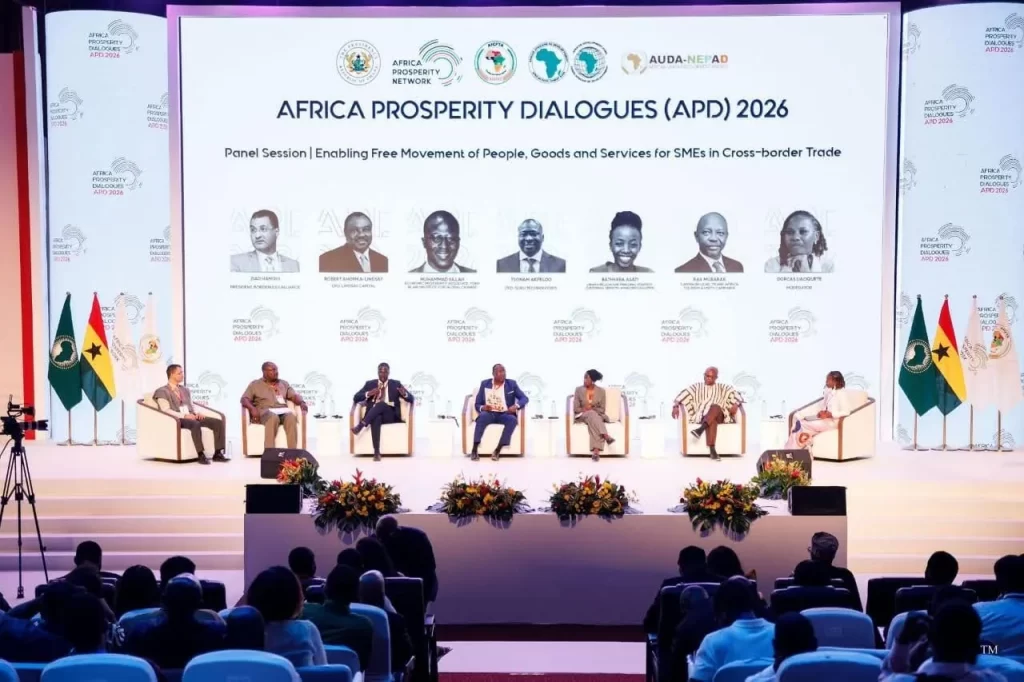
Standing on the stage of the Africa Prosperity Dialogues 2026, beneath a bold circular emblem reading ‘Make Africa Borderless Now,’ Borderless Alliance joined the official launch of a campaign whose name leaves little room for ambiguity about its intent. The initiative, spearheaded by the Africa Prosperity Network during its annual APD conference, set out to do something conferences on free movement have attempted many times before but rarely achieved: move the agenda out of the meeting room and onto the street.
Ziad Hamoui, National President of Borderless Alliance, took his place on a panel titled ‘Enabling Free Movement of People, Goods and Services for SMEs in Cross-border Trade,’ sharing the stage with figures including Robert Ahomka-Lindsay of Lindsay Capital, Muhammad Killah of the Blair Institute for Global Change, Tsonam Akpeloo of Suru Technologies, and moderator Dorcas Uacquitre, among others convened under the APD 2026 banner alongside the African Union, AfCFTA Secretariat, and AUDA-NEPAD.
The panel’s framing, centred specifically on SMEs, was deliberate. Free movement debates can easily drift into abstraction, discussed in terms of protocols and ratification statuses rather than the concrete experience of the small and medium-sized enterprises that make up the overwhelming majority of cross-border traders in West Africa. Anchoring the conversation in SME experience kept the discussion tethered to the people who actually feel the cost of a closed or friction-filled border most acutely.
What makes the ‘Make Africa Borderless Now’ campaign distinct from previous integration advocacy is its explicit strategy of shifting the regional integration agenda away from conference halls and toward the grassroots, empowering African citizens and businesses to demand full implementation of existing agreements rather than waiting for governments to act on commitments already made. It is a bet that public pressure, mobilised directly, can succeed where years of institutional advocacy alone have not.
That strategic choice reflects a frustration familiar to anyone who has followed African regional integration for any length of time: the gap between signed protocols and lived reality. The African Union’s Free Movement Protocol, ECOWAS’s own free movement framework, and AfCFTA’s market access commitments all exist on paper in forms that would, if fully implemented, transform how easily people, goods, and services cross African borders. The campaign’s premise is that implementation has stalled not for lack of agreements but for lack of sustained pressure to honour them.
The campaign’s call to action, ‘Add Your Voice Today,’ directed supporters to a petition at makeafricaborderlessnow.com, a digital mobilisation tool that lets the initiative scale its reach well beyond the delegates physically present at the Africa Prosperity Dialogues. Petitions of this kind rarely force policy change on their own, but they serve a documentary function, building a visible, countable record of public demand that advocacy organisations like Borderless Alliance can subsequently cite in more formal engagements with governments and regional institutions.
For Hamoui and Borderless Alliance, association with this campaign extends the organisation’s advocacy work into explicitly public-facing territory, complementing the more technical, committee-based engagement that defines much of the Alliance’s activity elsewhere in this catalogue. Where quarterly CPOC meetings and technical validation workshops operate largely out of public view, a campaign like this one is designed to be visible, shareable, and rallying by construction.
The Africa Prosperity Dialogues itself, held under the banner APD 2026 and featuring the flags of Ghana alongside African Union and continental trade institution branding on stage, situates this campaign launch within a broader annual gathering focused on Africa’s economic prosperity agenda. Launching ‘Make Africa Borderless Now’ at APD, rather than at a dedicated standalone event, allowed the campaign to draw on the energy and attention of a conference already focused on practical continental economic advancement.
Agenda 2063, the African Union’s long-term continental development framework, provides the campaign’s ultimate reference point. The Union’s commitments to free movement sit within this broader 50-year vision for African integration, and the campaign’s explicit framing, pushing implementation in line with Agenda 2063, positions ‘Make Africa Borderless Now’ not as a standalone protest but as an accountability mechanism for a continental commitment that African governments have already, formally, signed up to.
Whether the campaign succeeds in translating grassroots petition signatures into accelerated policy implementation remains, inherently, a matter for the months and years following its launch to determine. What is clear from the Accra stage in early 2026 is that Borderless Alliance chose to lend its name and its National President’s voice to a genuinely different mode of advocacy, one betting that African citizens demanding a borderless continent, loudly and visibly, might succeed where quieter diplomatic pressure has so far fallen short.